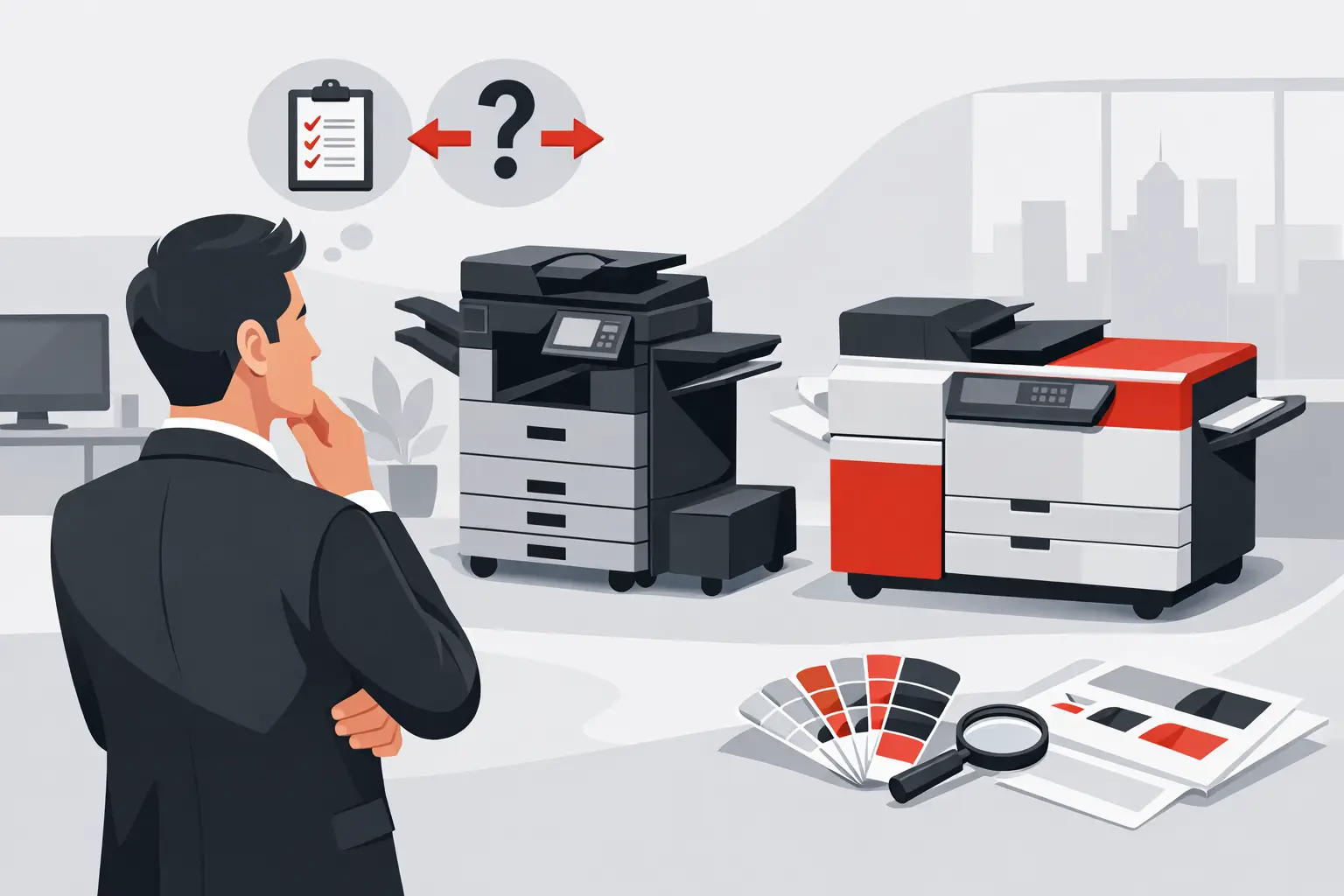
How to Choose a Commercial Printer
A print job rarely goes wrong all at once. It usually starts with a late proof, a vague quote, a stock substitution nobody flagged, or a supplier who says yes to everything and sorts it out later. If you are figuring out how to choose commercial printer services for your business, that is the real job – finding a partner who can prevent small issues from becoming expensive ones.
For marketing teams, office managers, franchise groups, agencies, and growing businesses, the stakes are practical. You need your materials to look right, arrive on time, stay on brand, and fit the budget. The cheapest quote will not always do that. Neither will the biggest print company. The right commercial printer is the one that can deliver consistent results with the right level of support for the work you actually do.
Start with the kind of work you need done
Before you compare suppliers, get clear on what you need printed and how often. A printer that is excellent for short-run flyers may not be the best fit for multi-page booklets, signage, direct mail, or recurring branded materials across multiple locations.
That matters because commercial printing is not one service. It covers a wide spread of production methods, finishing options, file requirements, and fulfillment needs. Business cards, presentation folders, brochures, NCR books, posters, outdoor banners, and promotional products all bring different demands. If your projects span several categories, you will save time by working with a supplier that can manage them under one roof or at least coordinate them properly.
This is also where volume matters. Some printers are built for one-off projects. Others are set up for ongoing business print, where repeatability and process control matter more than a one-time deal. If your team orders the same materials every month or across several branches, consistency becomes a major buying factor.
How to choose commercial printer support, not just output
A commercial printer is not just buying ink on paper. You are buying communication, process, and problem-solving. That is why service quality deserves as much attention as print samples.
Ask how the job will actually move from quote to delivery. Will someone review your files before production? Can they help if artwork is not press-ready? Will you get practical advice on stock, size, finish, or mailing requirements? If something changes mid-project, is there a real person taking ownership?
A lot of print problems come from the gap between what a customer thinks they ordered and what the supplier thinks they need to produce. Strong support closes that gap early. It can also protect your budget. A printer that flags a layout issue before press, or suggests a more efficient size or finishing method, may save more money than a lower unit price ever will.
For many business buyers, this is the difference between a vendor and a print partner. One takes the order. The other helps make the project successful.
Look closely at capabilities and limitations
Every printer has strengths. Good suppliers will be upfront about them. If a company claims to handle everything equally well, ask more questions.
You want to know what equipment, production workflows, and finishing services they can support with confidence. That includes things like digital versus offset printing, large-format capability, binding, folding, die-cutting, variable data, mailing, kitting, and distribution. If your work includes branded rollouts, sales kits, signage, or campaign collateral with several moving parts, the finishing and fulfillment side matters just as much as the print itself.
There is also a practical question behind capability: can they scale with you? A supplier that handles your current needs but struggles when volumes increase, or when you need multiple versions fast, can become a bottleneck.
That does not mean bigger is always better. Sometimes a highly responsive mid-sized commercial printer is a better fit than a large operation where your job disappears into the queue. What matters is whether their setup matches your complexity, volume, and turnaround expectations.
Price matters, but quoting quality matters more
Every business cares about cost. That is sensible. But if you are comparing print suppliers on price alone, you are likely comparing incomplete information.
A good commercial print quote should be clear about specifications. Stock, size, page count, quantity, finishing, packing, freight, and turnaround should all be easy to understand. If a quote is vague, there is room for misunderstanding and surprise charges later.
This is one of the simplest ways to tell whether a printer runs a disciplined operation. Clear quoting usually reflects clear production planning. It also makes it easier to compare suppliers fairly.
Be careful with prices that look dramatically lower than the rest. Sometimes that is genuine efficiency. Sometimes it means corners are being cut on stock quality, proofing, finishing, service time, or delivery. A lower print cost can become a higher campaign cost if materials arrive late, inconsistent, or unusable.
Review samples with your real-world standards
Print samples are useful, but only if you review them like a business buyer rather than a casual observer. Do the colors look consistent? Is the trimming clean? Are folds accurate? Does the stock suit the purpose? Does the piece feel polished in hand?
If you produce premium marketing materials, presentation folders, or customer-facing collateral, finish quality says a lot about your brand. On the other hand, if you run high-volume operational print, the test may be durability, readability, and repeatability rather than luxury feel.
Ask for samples that match the kind of work you actually need. A beautiful art booklet does not tell you much about whether a supplier can handle branded stationery packs, direct mail campaigns, or retail signage. The closer the sample is to your real job, the more useful the assessment.
Turnaround times need honesty, not optimism
Fast turnaround is valuable, but only when it is realistic. Many buyers have been caught by suppliers who promise aggressive deadlines to win the work, then miss them once files are submitted.
When evaluating a printer, ask what standard turnaround looks like and what can genuinely be expedited. Ask what affects the timeline – proof approval, stock availability, finishing, freight, mailing, or split deliveries. If you have regular deadlines, campaign launch dates, or event schedules, make sure the supplier understands the consequences of delay.
This is especially important if you serve multiple offices or locations. Coordinated delivery can be harder than printing the job itself. A dependable printer will talk through that early rather than treating distribution as an afterthought.
Brand consistency should be part of the conversation
If your business has multiple stakeholders ordering print, brand control matters. Franchise groups, real estate offices, corporate teams, and agencies often struggle when different people place orders in different ways and get inconsistent results.
A strong commercial printer should have a process for maintaining consistency across repeat orders. That may include stored artwork, controlled templates, approved specifications, reprint history, or online ordering systems for standardized items. These tools reduce mistakes, protect brand presentation, and make life easier for busy teams.
If your print supplier cannot explain how they manage repeatability, expect inconsistency over time. That may not show up on the first order, but it usually appears once multiple users, versions, or deadlines are involved.
Ask how they handle problems
This may be the most revealing question of all. No production environment is perfect. Files arrive incomplete. Freight gets delayed. Specs change. The issue is not whether something can go wrong. It is how your printer responds when it does.
Ask what happens if there is a color issue, a damaged delivery, a file problem, or a timing crunch. Listen for ownership. The best suppliers do not hide behind process when a project needs attention. They communicate early, offer options, and work the problem until it is resolved.
That mindset is often what separates average providers from long-term partners. At Dynamite Printing, that hands-on approach is exactly what many business customers value most – practical support from concept through production, finishing, and fulfillment.
The best choice depends on your business model
There is no single formula for how to choose commercial printer services because the right answer depends on what your business needs most. If you run frequent campaigns, responsiveness may matter more than rock-bottom pricing. If you manage a large brand network, systems and consistency may be the priority. If you buy complex print across several formats, production range and coordination may be the deciding factors.
That is why the smartest buyers look beyond a single job. They choose a printer based on whether the relationship will make future work easier, faster, and more reliable. A good commercial printer should reduce friction, not add to it.
When you find a supplier that communicates clearly, quotes accurately, produces consistently, and takes responsibility when it counts, hold onto them. Good print is visible. Good print support shows up everywhere else.