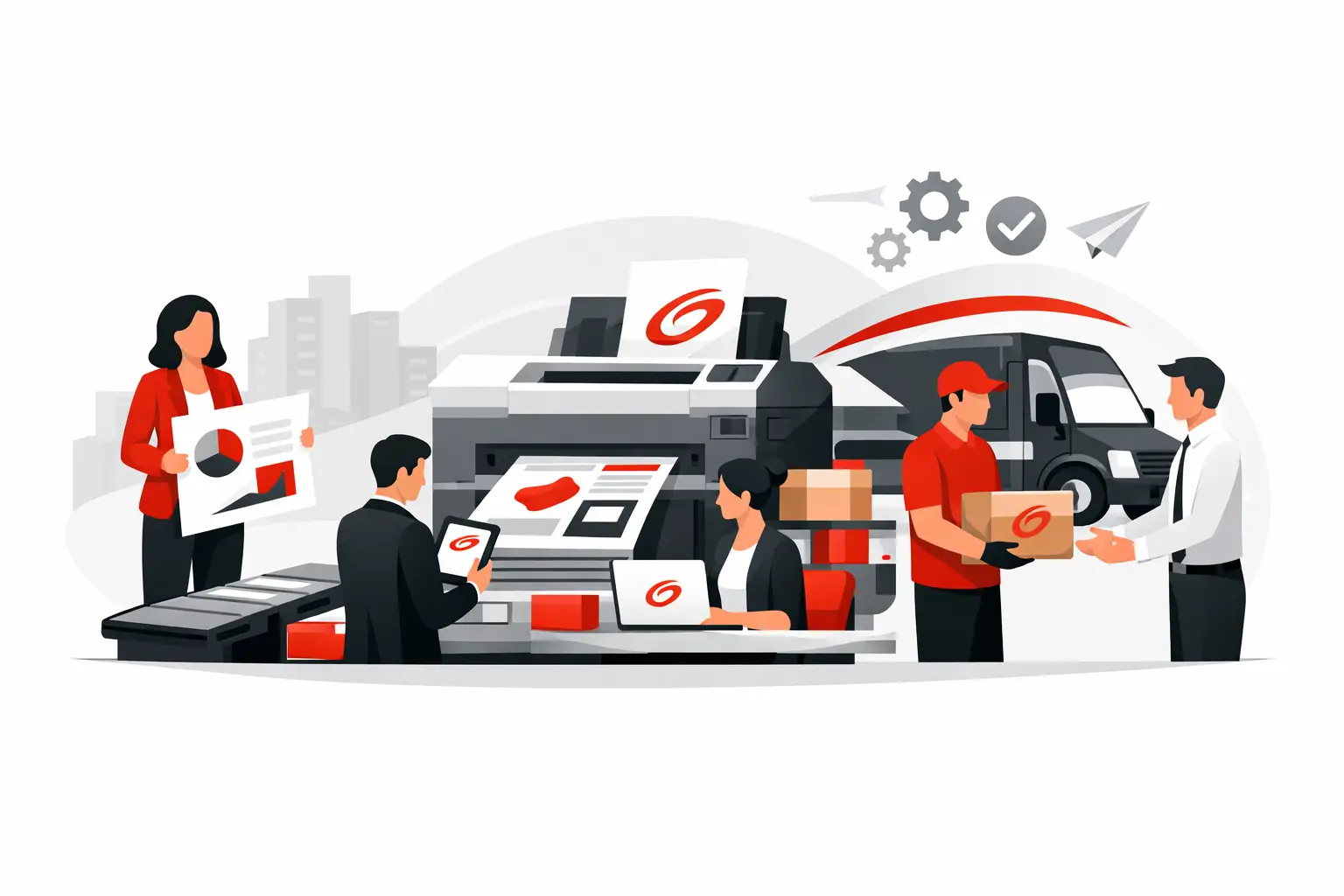
Print Fulfillment for Corporate Teams That Works
A marketing manager should not have to chase cartons, fix outdated flyers, or answer emails from five offices asking where to order business cards. Print fulfillment for corporate teams turns that daily friction into a controlled process: approved materials are produced, stored, ordered, packed, and delivered when and where they are needed.
For growing businesses, franchise groups, and multi-location organizations, that control protects more than a print budget. It protects brand standards, staff time, and the customer experience. The right fulfillment setup gives every team access to the materials they need without giving every person the ability to create their own version of the brand.
What print fulfillment means for corporate teams
Print fulfillment is the management of printed and branded materials after they have been produced. Rather than printing a job and sending all of it to one office, a print partner can hold inventory and dispatch individual orders to branches, staff members, events, customers, or campaign locations.
That can include everyday essentials such as business cards, letterhead, presentation folders, NCR books, brochures, and envelopes. It can also cover campaign collateral, point-of-sale signage, banners, display materials, welcome packs, uniforms, promotional products, and event kits.
The value is not simply warehousing boxes. A well-run program connects brand-approved artwork, production specifications, inventory levels, ordering rules, packing requirements, and delivery details. Corporate teams can order what they need from a defined range, while marketing and procurement retain visibility over what is being used and where it is going.
Why ad hoc ordering creates expensive problems
Many organizations begin with a familiar arrangement: each office or department emails a printer when it needs something. It can work when there are only a few orders and a small number of people involved. As the company expands, the gaps become harder to ignore.
One office orders an old brochure because it was saved on a desktop. Another chooses a slightly different paper stock. A new employee uses a logo downloaded from an outdated folder. Sales teams run out of folders before a major meeting because nobody could see the stock level. None of these issues looks major in isolation, but together they weaken brand consistency and create unnecessary spend.
Ad hoc ordering also makes budgeting difficult. Without a central view, it is hard to tell whether a branch is ordering for genuine demand, stocking up unnecessarily, or repeatedly paying for small, inefficient print runs. Teams may spend more time approving routine requests than they spend improving their campaigns.
Print fulfillment does not eliminate every exception. Urgent launches, regional promotions, and custom client presentations still need a hands-on response. It does, however, remove the repeated work from common orders and gives exceptions a clearer path to approval.
Build the right catalog before you store anything
The strongest fulfillment programs start with a practical review of what people actually use. It is tempting to upload every historical item to an ordering portal, but an oversized catalog quickly becomes difficult to manage. Start with the materials that are ordered frequently, required by every location, or critical to brand presentation.
For each item, confirm the approved artwork, size, stock, finish, quantity options, and reorder point. Decide whether personalization is allowed. A business card template may permit individual names, titles, phone numbers, and locations, while a corporate brochure should remain locked to approved artwork.
This is also the right time to retire materials that no longer serve a purpose. If a flyer is updated every quarter, printing and storing a year’s supply may create waste. If branded folders are used consistently across the business, a larger production run and managed inventory may be the smarter choice. The best approach depends on the item’s shelf life, demand pattern, storage footprint, and cost to produce.
Separate stable items from changeable ones
Stable items are usually the best candidates for inventory. Think generic presentation folders, branded envelopes, display hardware, event table covers, and evergreen brochures. They have a longer useful life and can often be produced more efficiently in volume.
Changeable items need closer control. Campaign flyers, price lists, seasonal offers, compliance documents, and staff-specific materials may be better produced in shorter runs or printed on demand. This reduces the risk of holding materials that become inaccurate before they are used.
A dependable print partner will help make those calls rather than pushing every job into one production model. Lower unit cost matters, but not if half the order ends up obsolete in a storage room.
Make ordering easy without losing brand control
An online ordering portal is often the working center of print fulfillment for corporate teams. Done properly, it gives authorized users a straightforward way to select approved products, enter permitted details, nominate delivery addresses, and place orders without rebuilding artwork every time.
The key is setting permissions that match how the organization works. A head office marketing team may approve new products and campaign materials. Regional managers may be able to order from the full catalog. Individual branches may only access their own standard items and approved quantities. Finance or procurement may need reporting access without being involved in every order.
That structure reduces bottlenecks while keeping control where it belongs. It also helps new locations get operational faster. Instead of receiving a bundle of files and a list of supplier contacts, they can order from an established range that already meets company standards.
Clear product descriptions matter here. Staff should know whether they are ordering a customer handout, a trade show kit, or internal stationery. Include quantity guidance where it helps, especially for materials that have minimum production quantities or are expensive to ship.
Treat inventory as a service, not a pile of boxes
Fulfillment only works when stock is accurate and easy to access. That means recording inventory as it is received, monitoring quantities as orders leave, and agreeing on reorder points before an item reaches zero.
Reorder points should reflect lead times and real usage. A fast-moving brochure used by dozens of offices needs more buffer stock than a specialty banner ordered twice a year. Seasonal demand matters too. If your busiest period is tied to conferences, recruitment, or a major sales season, stock planning needs to happen well before the rush.
Packing and distribution deserve the same attention. A carton sent to a central office may be cost-effective for bulk materials. Individual pick-and-pack orders may be better for remote staff, branches, or event locations. For campaign launches, kits can be assembled in advance so every location receives the same set of materials at the same time.
This is where a full-service print partner earns its place. Production knowledge matters, but so does the ability to coordinate finishing, storage, labeling, packing, and dispatch without passing responsibility between several suppliers.
Keep reporting focused on decisions
Corporate teams do not need reports for the sake of reports. They need information that helps them plan purchases, identify waste, and maintain service levels.
Useful reporting shows what has been ordered, by whom, in what quantities, and to which locations. It can reveal whether a particular item should be held in stock, ordered less often, or replaced with a more useful alternative. It also gives marketing teams evidence when they need to defend brand spend or prepare for a larger rollout.
Review the catalog periodically. Brand updates, new product lines, office closures, and changes in staff behavior can all affect what should be held. A quarterly review is often enough for stable programs, while high-volume or campaign-driven organizations may need more frequent checks.
Choose a partner that can solve the exceptions
Technology makes repeat orders easier, but service is what keeps the program moving when something changes. Look for a print provider that can advise on artwork, production methods, finishing options, variable data, signage, mailing, and promotional products – not just take an online order.
You also need clear communication when an item is low, artwork is unsuitable, or a delivery deadline needs a different approach. The right partner takes ownership of the outcome and gives practical advice before a small issue becomes a missed deadline.
Dynamite Printing helps corporate teams bring production, storage, online ordering, and distribution into one managed process. That gives internal teams less administration to carry and a dependable point of contact when the job is not standard.
A good fulfillment program should feel almost invisible to the people placing routine orders. They get the right materials, in the right version, delivered to the right place. Behind the scenes, your brand stays organized, your inventory stays accountable, and your team has more time for work that moves the business forward.