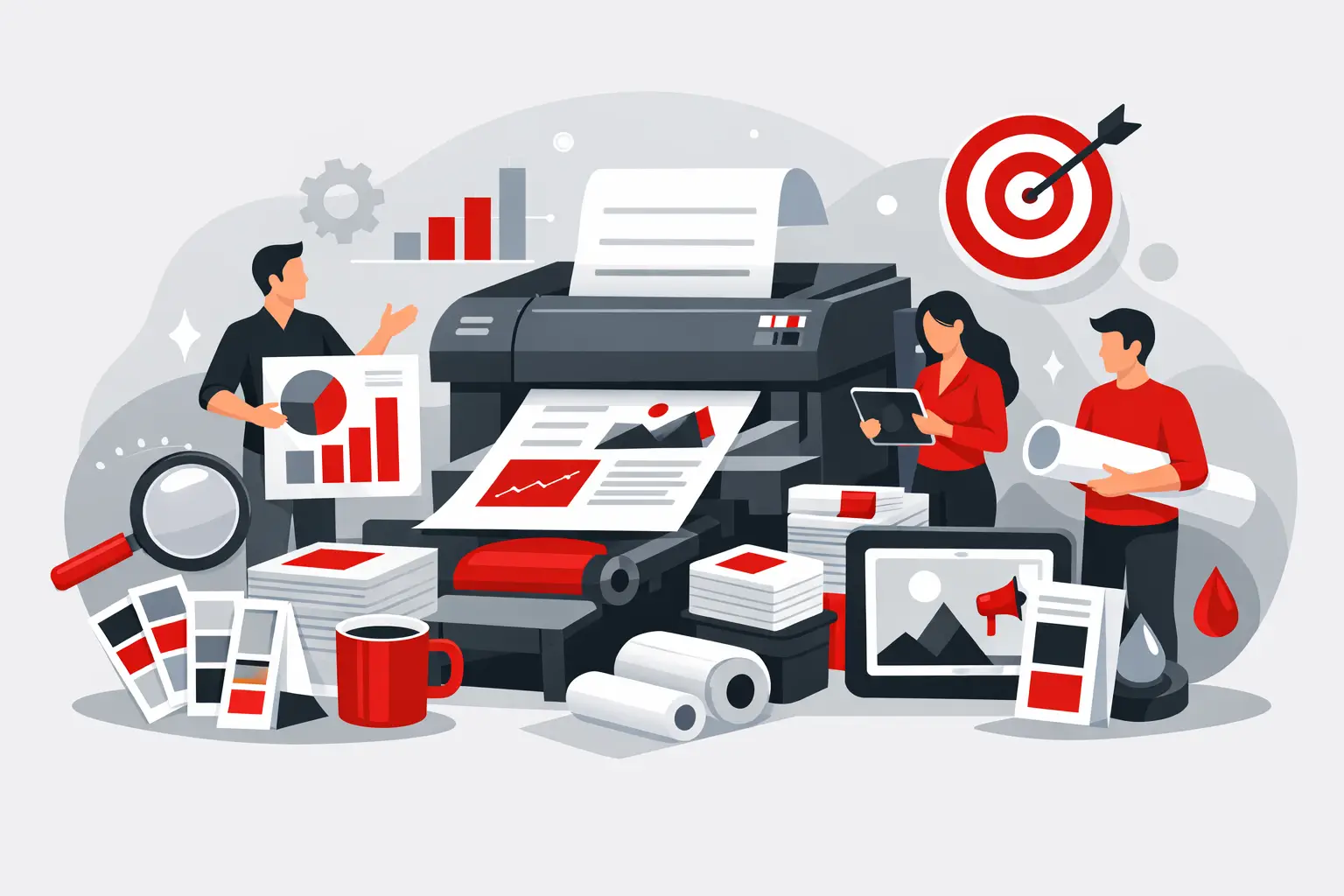
Commercial Printing for Marketing Teams
A campaign can look sharp on a screen and still fall apart in the real world. The brochure stock feels flimsy. The event banner is the wrong size. The direct mail piece lands late. That is why commercial printing for marketing teams is not just about getting ink on paper. It is about protecting timelines, brand standards, budget, and the overall quality of the campaign.
Marketing teams are usually managing more than one moving part at a time. A product launch might need brochures, presentation folders, signage, window graphics, postcards, and promotional merchandise, all with different specs and delivery dates. When print is treated like a simple commodity purchase, mistakes show up late and cost more to fix. When it is handled by a capable print partner, the process gets easier, risks are caught earlier, and the finished materials do the job they were meant to do.
What marketing teams really need from commercial printing
Most marketing departments are not looking for a printer in the narrow sense. They are looking for a reliable production partner that can keep work moving. That means fast quotes, practical advice, accurate proofs, dependable turnaround, and someone who notices problems before they become expensive.
The challenge is that print buying often sits between creative, procurement, sales, and operations. One team cares most about visual quality. Another is focused on cost control. Another needs materials delivered to multiple locations. Commercial printing for marketing teams has to support all of those priorities at once.
That is why service matters as much as machinery. A strong print supplier can help with artwork setup, recommend more efficient formats, manage finishing details, and coordinate fulfillment. For busy marketers, that support removes friction. It also reduces the amount of internal follow-up needed to get a campaign out the door.
Why print still earns its place in the mix
Digital channels move fast, but print still has a very practical role in marketing. It gives people something physical to keep, review, hand to someone else, or use in a face-to-face conversation. In B2B settings especially, printed materials often carry more weight because they signal preparation and professionalism.
That does not mean every campaign needs a big print run. Sometimes a short-run booklet is smarter than a bulk order. Sometimes a targeted direct mail piece outperforms a generic handout. Sometimes large-format signage does more heavy lifting than a stack of flyers. The right print solution depends on how the material will be used, who it is for, and how long it needs to last.
Print also fills the gaps that digital cannot always cover well. Trade shows, retail displays, sales presentations, franchise rollouts, real estate marketing, and local area promotions all depend on physical branded materials. In those moments, quality is visible. Poor alignment, weak color, thin stock, or inconsistent finishes reflect directly on the brand.
Choosing the right materials for the job
One of the most common mistakes marketing teams make is specifying print based only on appearance. A piece can look good in a mockup and still be wrong for the job. The stock may be too light for a premium presentation. The coating may make it hard to write on. The folded format may not suit the information hierarchy.
Good commercial printing starts with function. Ask where the item will be used, how long it needs to last, who will handle it, and whether it needs to be mailed, displayed, or carried. A sales folder has different demands than a product catalog. A window decal behaves differently than an outdoor banner. An event handout should not be treated the same way as a leave-behind piece for a high-value client.
This is where experience saves time. A knowledgeable print team can guide decisions on paper weight, finish, binding, size, durability, and production method before the job goes to press. That advice may not seem dramatic, but it prevents the kind of rework that eats budgets.
Commercial printing for marketing teams with tight deadlines
Marketing timelines are rarely generous. Campaign dates are fixed, approvals arrive late, and last-minute changes are part of the job. In that environment, speed matters, but controlled speed matters more.
A rushed print job without proper checking can create bigger delays than it solves. Incorrect bleeds, low-resolution images, missing fonts, wrong versions, or incomplete delivery instructions are common causes of trouble. Marketing teams need a supplier that can move quickly without skipping the essentials.
That usually means having clear prepress processes, responsive communication, and production capacity that can handle volume when needed. It also means being honest about trade-offs. If the deadline is immovable, there may need to be a change in stock, finishing, or delivery method. A dependable printer will explain those choices clearly instead of overpromising and hoping for the best.
For larger organizations, repeatability is just as important as speed. If your team regularly orders brochures, signage, stationery, point-of-sale material, or promotional products, standardized ordering can save serious time. Online ordering portals, templated artwork, and stored specifications help marketing teams keep control while reducing admin.
Brand consistency is a production issue, not just a design issue
Marketing leaders spend a lot of time building brand consistency, but that work can come undone in production. Different substrates absorb ink differently. Large-format graphics behave differently than brochures. Color can shift across print methods if files and expectations are not managed properly.
That is why brand consistency should be discussed before printing, not after delivery. Pantone matching, finish selection, substrate choice, proofing, and tolerances all matter. So does understanding where flexibility is acceptable and where it is not. A premium brand launch may require tighter control than a short-term local promotion.
For multi-site businesses, franchise groups, and regional teams, consistency becomes even more critical. Marketing materials need to look like they came from one brand, even when they are delivered to different offices or adapted for local use. Commercial printing for marketing teams should make that easier through controlled templates, approved assets, and consistent production standards.
Cost control without cutting the wrong corners
Every marketing team has budget pressure. The problem is that the cheapest print quote is not always the lowest-cost outcome. Reprints, freight errors, delayed launches, poor presentation, and unusable stock all create hidden costs.
A better approach is to look at total job value. That includes unit price, yes, but also accuracy, durability, turnaround, packaging, warehousing, version control, and delivery coordination. In some cases, consolidating multiple items with one print partner reduces cost through simpler management alone.
There are also smart ways to trim spend without weakening the result. Adjusting size to fit more efficiently on press sheets, reducing excessive page counts, choosing a more suitable stock, or combining runs can all help. The key is knowing which changes are invisible to the audience and which ones will cheapen the finished piece.
That balance is where a hands-on print partner earns their keep. The goal is not to sell more print than you need. The goal is to make the project work on budget and on time.
What to look for in a print partner
If your marketing team handles recurring campaigns, multiple product lines, or distributed locations, you need more than a vendor who can process files. You need a team that can manage complexity without creating more work for you.
Look for practical strengths. Can they support design and artwork if needed? Can they handle short runs and high-volume production? Do they offer signage, direct mail, branded merchandise, and business print in one place? Can they pack, store, and distribute materials across multiple offices? Can they spot issues early and speak plainly about solutions?
Those questions matter because marketing teams are measured on outcomes, not on how cheaply they bought paper. A reliable partner helps you hit launch dates, present the brand properly, and avoid last-minute surprises. That is especially valuable when campaigns involve many formats or stakeholders.
Dynamite Printing has built its work around that reality – practical support, broad production capability, and a real commitment to making each print project a success.
Print works best when it is planned early, specified properly, and managed by people who take responsibility for the result. For marketing teams, that is not a nice extra. It is what keeps campaigns moving.