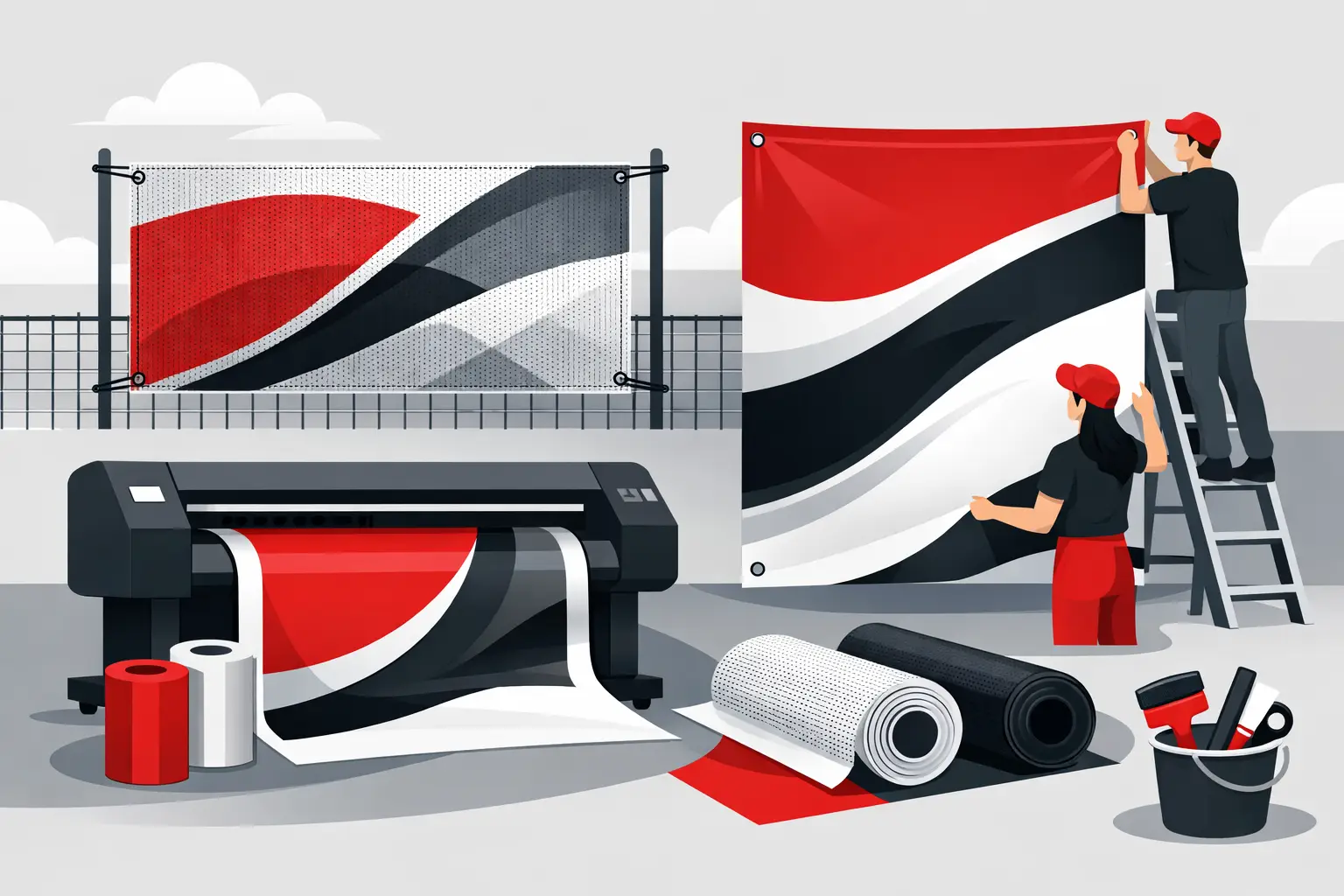
Mesh & Vinyl Banners Printing That Works
A banner that curls at the edges, tears in the wind, or washes out in direct sun does not just look bad – it reflects badly on the business behind it. That is why mesh & vinyl banners printing is not a one-size-fits-all job. The right material, finish, and installation method all matter if you want signage that holds up and does its job.
For marketers, operations teams, franchise groups, and business owners, banners are often a fast way to solve a visibility problem. You might need to promote a sale, cover a fence line, dress a construction site, support an event, or brand a storefront. The challenge is choosing the format that fits the location, weather exposure, viewing distance, and budget without creating headaches later.
Mesh & vinyl banners printing: what is the difference?
At a glance, mesh and vinyl banners can look similar. Both are large-format printed signs used indoors and outdoors, and both can carry bold branding, promotions, and directional messaging. The difference is in how they perform once they are up.
Mesh banner material is perforated with tiny holes that allow air to pass through. That makes it a smart choice for exposed outdoor locations where wind load is a real issue, such as fence wraps, scaffold signage, building perimeters, and sports grounds. It is built for environments where a solid banner might act like a sail.
Vinyl banners are printed on a solid PVC-based material with a smooth surface. They tend to deliver stronger color density and sharper image reproduction, especially for close-up viewing. Vinyl is often the better option for storefronts, indoor displays, event branding, point-of-sale promotions, and outdoor placements where wind is less of a factor.
Neither option is automatically better. It depends on where the banner will be used and what matters most – durability in windy conditions, image quality, opacity, lifespan, or cost.
When mesh banners make more sense
If your banner is going on temporary fencing, a chain-link perimeter, or any large exposed outdoor structure, mesh is usually the safer call. The perforation helps reduce wind resistance, which lowers the chance of tearing, stretching, or pulling hardware loose.
That matters on construction sites, redevelopment projects, sports venues, and outdoor events. In these settings, banners are often large, highly visible, and subject to changing weather. A material that handles airflow better can save you from constant replacements and reinstallation costs.
There is a trade-off. Because of the open weave, mesh does not deliver the same solid, saturated look as vinyl. Up close, images can appear slightly softer. For bold logos, simple messaging, and high-visibility branding viewed from a distance, that is rarely a problem. For detailed artwork or photography-heavy creative, it may be.
Mesh also works well when you need some light and visibility to pass through the substrate. That can be useful on site fencing or wrapped barriers where a fully blocked-out surface is not ideal.
Best uses for mesh banners
Mesh performs best when function comes first. It is commonly used for perimeter fencing, scaffold wraps, large outdoor promotions, event barriers, and any installation where wind exposure is part of the equation. If the banner needs to stay up for an extended period outdoors, mesh often gives you a better balance of performance and practicality.
When vinyl banners are the better option
Vinyl shines when presentation is the priority. Its smooth surface reproduces crisp text, strong brand colors, and cleaner graphics, which makes it a reliable choice for customer-facing promotions.
Retail campaigns, showroom signage, trade show displays, indoor events, and wall-mounted promotional banners are all strong use cases. Vinyl is also a good fit for short- to medium-term outdoor signage in lower-wind areas, especially when the banner size is manageable and the installation point is secure.
If your audience will be standing close to the sign, vinyl usually looks more polished. That can matter in real estate marketing, product launches, franchise campaigns, and branded environments where consistency counts. For businesses with strict visual standards, the extra print clarity is often worth it.
That said, vinyl is not invincible. In high winds or on oversized outdoor installs, it can be more vulnerable if the job is not specified correctly. A good print partner will look at the banner dimensions, location, and fixing method before recommending it.
Best uses for vinyl banners
Vinyl is well suited to storefront promotions, indoor retail signage, event backdrops, sale banners, directional signs, and temporary outdoor advertising where visual impact matters more than airflow. If the goal is a cleaner finish and stronger image quality, vinyl is usually the right place to start.
What affects banner performance besides the material
Material choice is only one part of a successful banner job. Size, finishing, artwork setup, and installation method all have a direct impact on how the final product performs.
A large banner with weak finishing can fail even if the material itself is suitable. Hemming, reinforced edges, eyelets, pole pockets, and welds need to match the demands of the install. The same goes for the fixing points. A banner under tension behaves differently from one loosely tied to fencing, and that changes what is required for durability.
Artwork also matters more than many buyers expect. Low-resolution files, poor scaling, or weak contrast can make a professionally printed banner look average. For distance viewing, designs need to be simple and readable. For close-range use, resolution and alignment need more attention. This is where experienced prepress support earns its keep.
Color choice can be another practical factor. Outdoor conditions can change how colors appear throughout the day. Strong contrast and clear hierarchy generally outperform crowded layouts. If your message has to land in a few seconds from a passing car or across a job site, clarity beats clever design every time.
Choosing the right banner for your business use case
The easiest way to choose between mesh and vinyl is to start with the environment, not the artwork. Ask where the banner is going, how long it needs to last, how much wind it will face, and how close people will be when they read it.
If the answer involves fencing, scaffold, open-air exposure, or oversized outdoor coverage, mesh is often the practical choice. If the banner is being used indoors, on a building wall, in a retail setting, or in a more controlled outdoor area, vinyl may give you the better visual result.
Budget matters too, but cheapest upfront is not always cheapest overall. A lower-cost option that fails early, fades fast, or needs replacing after poor weather can end up costing more in production and labor. Businesses ordering across multiple sites or repeat campaigns usually benefit from getting the specification right from the beginning.
For franchise groups and multi-location brands, consistency becomes another factor. Standardizing banner sizes, material types, and artwork rules can reduce ordering friction and protect brand quality. That is especially useful when different teams are placing orders under time pressure.
Why expert support matters in mesh & vinyl banners printing
Banner printing looks simple until the job gets real-world conditions attached to it. Tight deadlines, uneven install surfaces, brand compliance, freight timing, and weather exposure all affect the result. That is why businesses usually get better outcomes when they work with a print partner that asks the right questions early.
A dependable supplier does more than print a file. They help confirm the right substrate, flag design issues before production, recommend finishing that suits the install, and keep the job moving on schedule. For larger rollouts or repeat business, that support can save time, reduce waste, and prevent expensive reprints.
At Dynamite Printing, that hands-on approach is exactly what business customers value. When a banner needs to look sharp, arrive on time, and perform as expected, practical advice matters just as much as the print itself.
The best banner is not the one with the biggest size or the glossiest finish. It is the one that suits the site, carries your message clearly, and keeps working for as long as you need it to. Get that part right, and a banner stops being just another print item and starts doing real work for your brand.